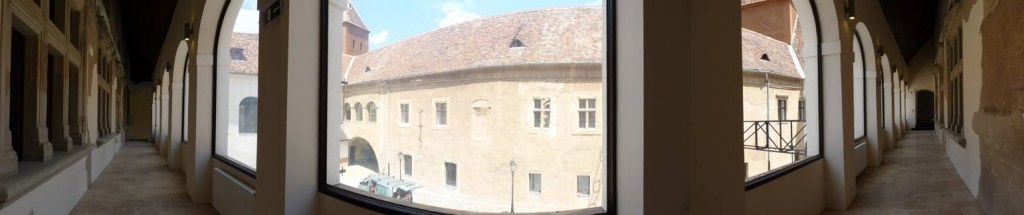
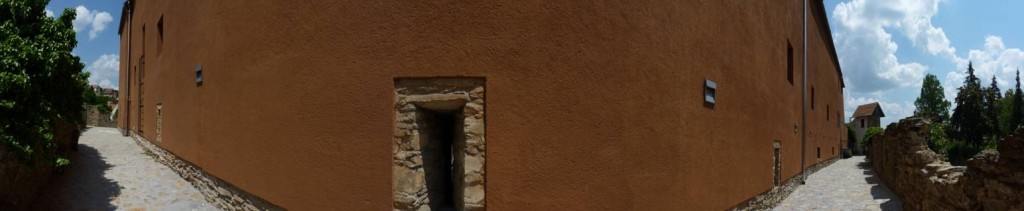
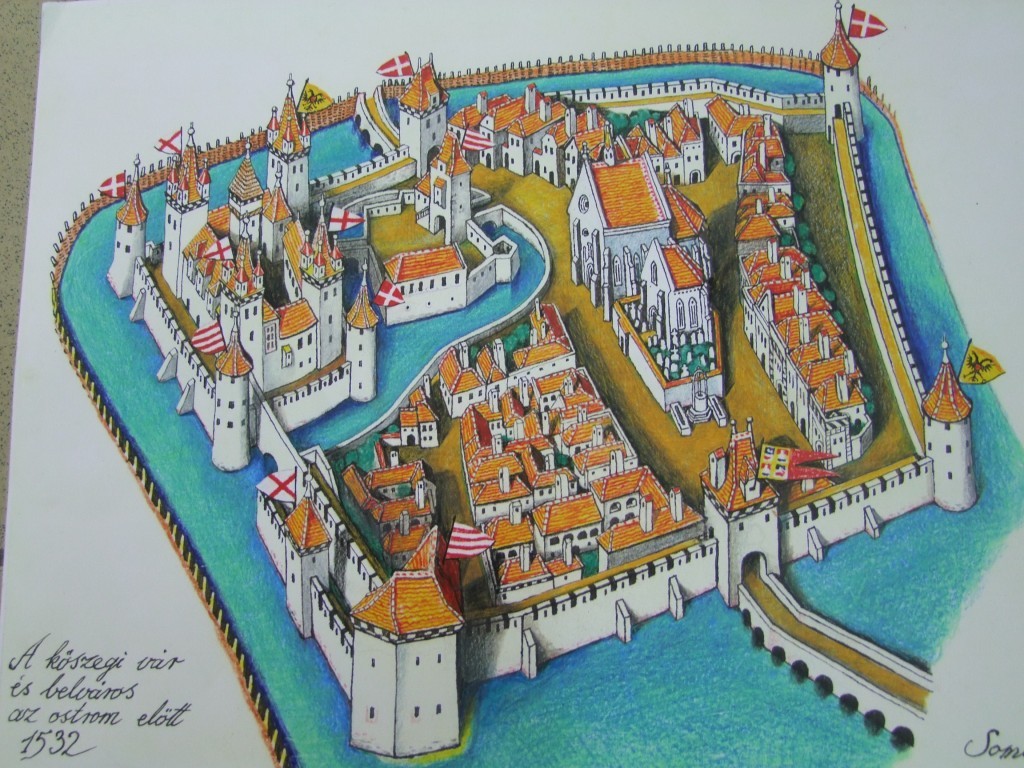
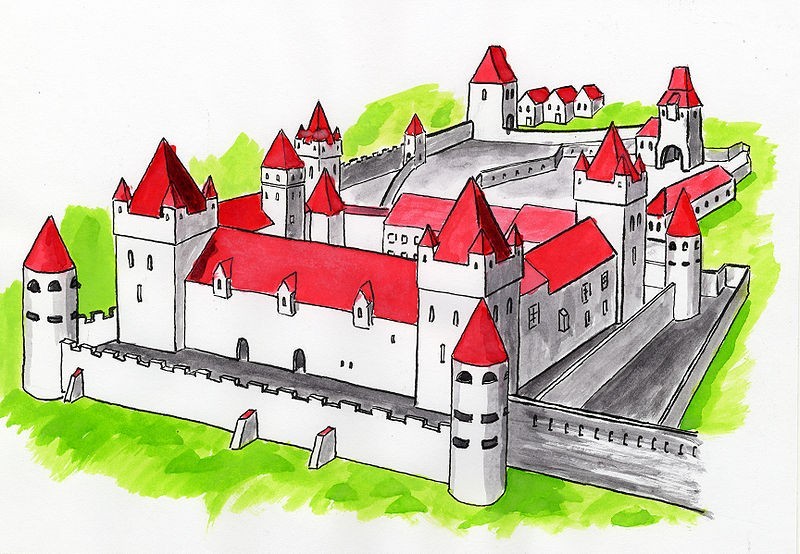
The buildings of the fortress served economic purposes. There was the carriage house, the stable and the watchtower. The inner castle from the courtyard can be reached over the brick bridge. This was built after the demolition of the leaf-bridge standing over the former moat. Apart from the Gothic wall paintings in the north wing, Renaissance paintings and graffitos are visible around the windows. The fortress was named after the captain of the castle who protected it against the attacks of the Ottoman army advancing to Vienna in 1532. Miklós Jurisics’s handful of men repulsed 19 sieges and the bell tolls, reminiscent of their victory, every day at 11 o’clock in Kőszeg.
In order to prevent Austrian invasions, city walls were built protected by strong towers. Water was channelled into the ditches that surrounded the walls from the nearby stream called Gyöngyös. In 1392, the castle belonged to the Garai family, in 1445 to the Habsburgs from whom Matthias Corvinus took it over in 1482 but the Habsburgs occupied it again in 1492. The castle is best known for its siege suffered from the vast army of the Turkish sultan, Suleiman advanced towards Vienna in 1532, against opposition from captain Miklós Jurisics who organized his army of a thousand men which consisted of partly his own military but mainly serfs fleeing in from nearby areas. The forces of the Ottoman Empire applied all possible means during the twenty-five days of fighting. Finally, by mutual consent, the Hungarians allowed eight Turkish flags to be planted on eight towers thus the Turkish general Ibrahim could report to the sultan about the apparent victory, so they could have marched south from the walls of Kőszeg. The sultan followed the events from the hill situated between Király-völgy (King Valley) and Kálvária-hegy (Mount Calvary). This place has been named Sultan Hill since then. As the city of Vienna was secured by major Austrian troops, Ferdinand Habsburg promoted Miklós Jurisics to barony and donated Kőszeg to him for his heroic bravery. Jurisics died without male offspring therefore the town was handed back to the royal chamber. In 1695, the castle and manor were acquired by Paul Esterházy (Palatine) and the family owned the castle until 1931. It was then sold and became a military property until 1955. In previous centuries, the market town was often besieged by troops of Transylvanian, imperial and insurrectionist forces because the houses of wealthy citizens were attractive booty. In 1777, the castle was destroyed by fire and then most of the ramparts were pulled down. |

Jurisics-vár Művelődési Központ és Várszínház
9730 Kőszeg, Rajnis u. 9.
Telefon: +36 94/360-113 • Fax: +36 94/563-244
E-mail: jurisics@koszeg.hu

Copyright © 2013 Jurisics Vár
Művelődési Központ és Várszínház
Művelődési Központ és Várszínház
Támogatók
A honlap fejlesztése az Európai Unió támogatásával valósult meg „Kőszegi Jurisics vár turisztikai fejlesztése – NYDOP-2.2.1/B-2f-2009” projekt részeként.